
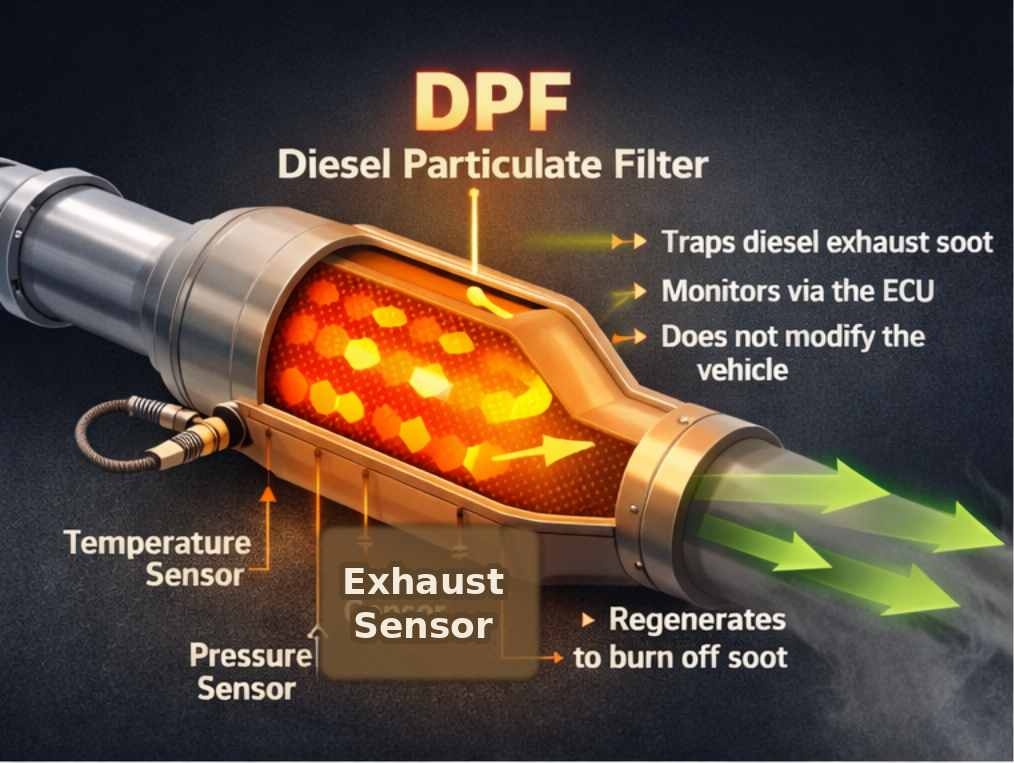
Fuel Consumption During DPF Regeneration – Why Interrupted Burn-Off Cycles Can Cost More Than Drivers Think
Modern diesel cars are efficient, torquey and extremely capable on long journeys. But every driver of a TDI-powered vehicle with a diesel particulate filter eventually encounters one issue that quietly affects running costs: active DPF regeneration. On paper, the process is normal. In practice, many owners only notice it when the car suddenly starts using more fuel, the idle speed changes slightly, the cooling fans run longer than expected, or the exhaust system becomes noticeably hotter than usual.
The real problem is not that regeneration happens. The real problem begins when the process is interrupted over and over again. A driver reaches home, turns the engine off after a short trip, then starts again later, only for the car to trigger another regeneration attempt. What should have been one clean, controlled burn-off cycle turns into repeated heating, repeated fuel enrichment and repeated stress for the whole system.
To illustrate the effect clearly, let us use a practical example: a VW Passat 2.0 TDI 150 HP. In normal driving conditions, we assume an average consumption of 6.4 l/100 km. During active DPF regeneration, we assume consumption rises to around 10.0 l/100 km. The burn-off cycle itself is assumed to last about 30 km. These are simple, easy-to-understand figures, but they show exactly why interrupted regeneration can hurt fuel economy so badly.

A longer out-of-town drive gives the DPF system the best chance to complete regeneration properly in one cycle.
What Does One Proper DPF Regeneration Really Cost?
First, let us calculate the fuel used over a 30 km distance in normal conditions. At 6.4 l/100 km, the Passat would use:
30 km × 6.4 l / 100 km = 1.92 litres
During an active DPF regeneration cycle, however, we assume the same car consumes 10.0 l/100 km. Over the same 30 km, that becomes:
30 km × 10.0 l / 100 km = 3.00 litres
The difference is easy to see:
3.00 litres – 1.92 litres = 1.08 litres
So one properly completed regeneration cycle costs approximately 1.08 litres of extra fuel compared with normal driving over the same distance. That is not insignificant, but it is still acceptable if the process finishes successfully, the soot load drops, the filter is cleaned and the car returns to normal operation.
In other words, a complete regeneration is a temporary fuel penalty that serves a clear purpose. It is a controlled maintenance event built into the operation of the engine and exhaust system. The trouble starts when the fuel is spent, but the job is not actually completed.
Why Interrupted Regeneration Is So Bad for Fuel Economy
Now let us look at the same car in a more realistic urban pattern. Imagine the driver begins an active regeneration, but shuts the engine off after only 10 km. The filter has started to heat up, extra fuel has already been injected, and the process is underway — but it is not finished. Later, the ECU tries again. If that second attempt is also interrupted, the whole cycle may be repeated several times before the filter is finally cleaned properly.
Here is how the numbers start to change:
Scenario 1 – One proper regeneration completed at the first attempt
- Fuel used during regeneration: 30 km × 10.0 l / 100 km = 3.00 litres
- Normal fuel use over the same distance: 1.92 litres
- Extra fuel: 1.08 litres
Scenario 2 – One interruption after 10 km, then one full 30 km regeneration
- First interrupted attempt: 10 km × 10.0 l / 100 km = 1.00 litre
- Second attempt, completed over 30 km: 3.00 litres
- Total fuel used: 4.00 litres
- Normal driving fuel over 40 km would be: 40 km × 6.4 l / 100 km = 2.56 litres
- Extra fuel: 4.00 – 2.56 = 1.44 litres
Scenario 3 – Two interruptions after 10 km each, then one full 30 km regeneration
- 10 km + 10 km + 30 km at regeneration consumption: 1.00 + 1.00 + 3.00 = 5.00 litres
- Normal driving fuel over 50 km would be: 50 km × 6.4 l / 100 km = 3.20 litres
- Extra fuel: 5.00 – 3.20 = 1.80 litres
Scenario 4 – Three interruptions after 10 km each, then one successful 30 km regeneration
- 10 km + 10 km + 10 km + 30 km at regeneration consumption: 1.00 + 1.00 + 1.00 + 3.00 = 6.00 litres
- Normal driving fuel over 60 km would be: 60 km × 6.4 l / 100 km = 3.84 litres
- Extra fuel: 6.00 – 3.84 = 2.16 litres
This is the key point. A proper regeneration already increases fuel consumption. But repeated interruptions make the situation much worse, because the car has to spend extra fuel several times before the DPF is finally cleaned. The fuel penalty is no longer a one-off event — it becomes a pattern.

During active regeneration, fuel consumption can rise sharply compared with ordinary mixed driving.
The Negative Effects of Repeatedly Interrupting a DPF Burn-Off Cycle
The increased fuel consumption is only the first and most visible consequence. In reality, interrupted regeneration affects the entire operating environment of the diesel engine.
1. More fuel is burned without fully solving the problem
This is the most obvious downside. The ECU enriches the combustion process in order to increase exhaust gas temperature and burn the soot trapped in the filter. If the regeneration is interrupted halfway through, the fuel has already been used, but the filter may still remain heavily loaded. The next drive may trigger the whole procedure again, which means the same job has to be paid for twice, or even four times.
2. The oil can be exposed to more stress
Active DPF regeneration often involves post-injection strategies. In repeated short-cycle use, some of that extra fuel can contribute to harsher conditions for the engine oil. Even when no immediate warning appears, interrupted regeneration can accelerate oil degradation and reduce the margin of safety for proper lubrication over time.
3. The filter remains loaded with soot for longer
A DPF works best when regeneration completes properly and the soot mass is reduced in one continuous process. If burn-off is repeatedly interrupted, the filter spends more time in a partially loaded state. That means the car operates for longer with elevated backpressure and reduced reserve before the next regeneration request.
4. Regenerations may occur more frequently
A diesel that regularly completes its regeneration cycles tends to behave predictably. A diesel that is constantly used on short trips can start asking for regeneration again and again. Drivers often interpret this as “the car suddenly uses too much fuel” or “something is wrong with the engine”, when in reality the vehicle is trying to finish a task that was interrupted several times before.
5. Warning lights and limp-mode risk become more likely
A single interruption will not usually create a drama. But a long-term habit of switching the engine off during active regeneration can push the DPF system closer to warning thresholds. Once soot load rises too far, the car may request a forced drive cycle, trigger a dashboard warning, or in more severe cases reduce performance to protect the drivetrain.
6. Overall diesel ownership becomes less economical
Diesel efficiency looks excellent on paper, but only when the car is used in a way that suits its aftertreatment system. A TDI that spends most of its life on short commutes, interrupted regenerations and stop-start traffic can end up costing more than expected. The driver pays not only in fuel, but also in earlier servicing, potential diagnostics, and more wear on systems that prefer fully completed heat cycles.

Stopping the car too early can leave the regeneration unfinished, forcing the vehicle to repeat the burn-off process later.
Why a Properly Completed Regeneration Is the Better Outcome
The positive side of the story is simple: a diesel behaves much better when the filter is allowed to regenerate properly. One completed cycle is always preferable to several interrupted attempts.
When the burn-off process finishes in one go, the soot load drops, backpressure is reduced, and the ECU no longer needs to keep retrying the same event. Fuel use returns to normal sooner. The engine, turbocharger and exhaust system operate in a more stable thermal environment. The driver experiences fewer repeated regeneration phases and less uncertainty about what the car is doing.
There is also a psychological benefit. A properly completed regeneration means the driver can move on. The system has done its work, the filter has been cleaned, and normal daily use can continue. With interrupted regeneration, the car seems to “carry unfinished business” from one trip to the next, and that makes ownership more frustrating.
In practical terms, the best environment for a diesel particulate filter is not endless idling, short 5 km trips or constant stop-start city traffic. It is a stable drive with enough distance and temperature for the regeneration cycle to finish properly. That is why diesel vehicles remain especially well suited to drivers who regularly cover medium or long routes.

Long-distance driving gives a diesel the chance to finish regeneration properly, while repeated short urban trips can keep the process incomplete.
Comparison Table – One Proper Regeneration vs Repeatedly Interrupted Regeneration
| Comparison Area | Car That Completes Regeneration at the First Attempt | Car With Habitually Interrupted Regeneration |
|---|---|---|
| Distance linked to the regeneration sequence | 30 km | 60 km |
| Fuel used during that sequence | 3.00 litres | 6.00 litres |
| Fuel that would be used in normal driving over the same distance | 1.92 litres | 3.84 litres |
| Extra fuel above normal use | +1.08 litres | +2.16 litres |
| Number of attempts needed to solve the same soot load problem | 1 | 4 |
| Oil stress risk | Lower | Higher |
| Risk of repeated future regenerations | Lower | Higher |
| Driving predictability | Stable and easier to manage | Less predictable and more frustrating |
| Long-term running cost outlook | More economical | More expensive |
Final Verdict
A DPF regeneration cycle is not a fault. It is a necessary maintenance process built into every modern diesel equipped with a particulate filter. The real danger appears when that process is interrupted repeatedly. In our VW Passat 2.0 TDI example, one complete regeneration causes an extra fuel use of around 1.08 litres. But if the driver keeps cutting the process short and the car has to restart it several times, that penalty can easily rise to 2.16 litres or more before the filter is finally cleaned.
That is why the smartest approach is simple: once regeneration has started, let the vehicle finish it if driving conditions allow. One properly completed cycle is always better than several wasted attempts. It reduces soot load more effectively, limits repeated fuel enrichment, and helps the whole diesel system work in a calmer, healthier operating range.
Monitoring the process makes that much easier. DPF Control is designed to help drivers see when active regeneration starts and ends, so they can avoid interrupting the cycle without realising it. You can find it in the official online shop here: DPF Control Online Shop.