DPFCONTROL.EU · STOP GUESSING. START KNOWING.
DPF Control Know When Your DPF Regenerates and Check Soot Levels
Is your diesel particulate filter regenerating right now? Has the cycle finished? How many grams of soot are in the filter? DPF Control gives you practical answers during everyday use.
DPF Control is for all VAG cars with TDI engines — Volkswagen, Audi, Škoda, SEAT, CUPRA, Porsche and Bentley. This compact DPF regeneration monitor signals the start and end of active regeneration and lets you check the soot value reported by your car. It works automatically when you start the car — without an app, smartphone or internet connection.

SOOT BUILDS UP. REGENERATION REDUCES IT.
Understanding the DPF Soot Cycle
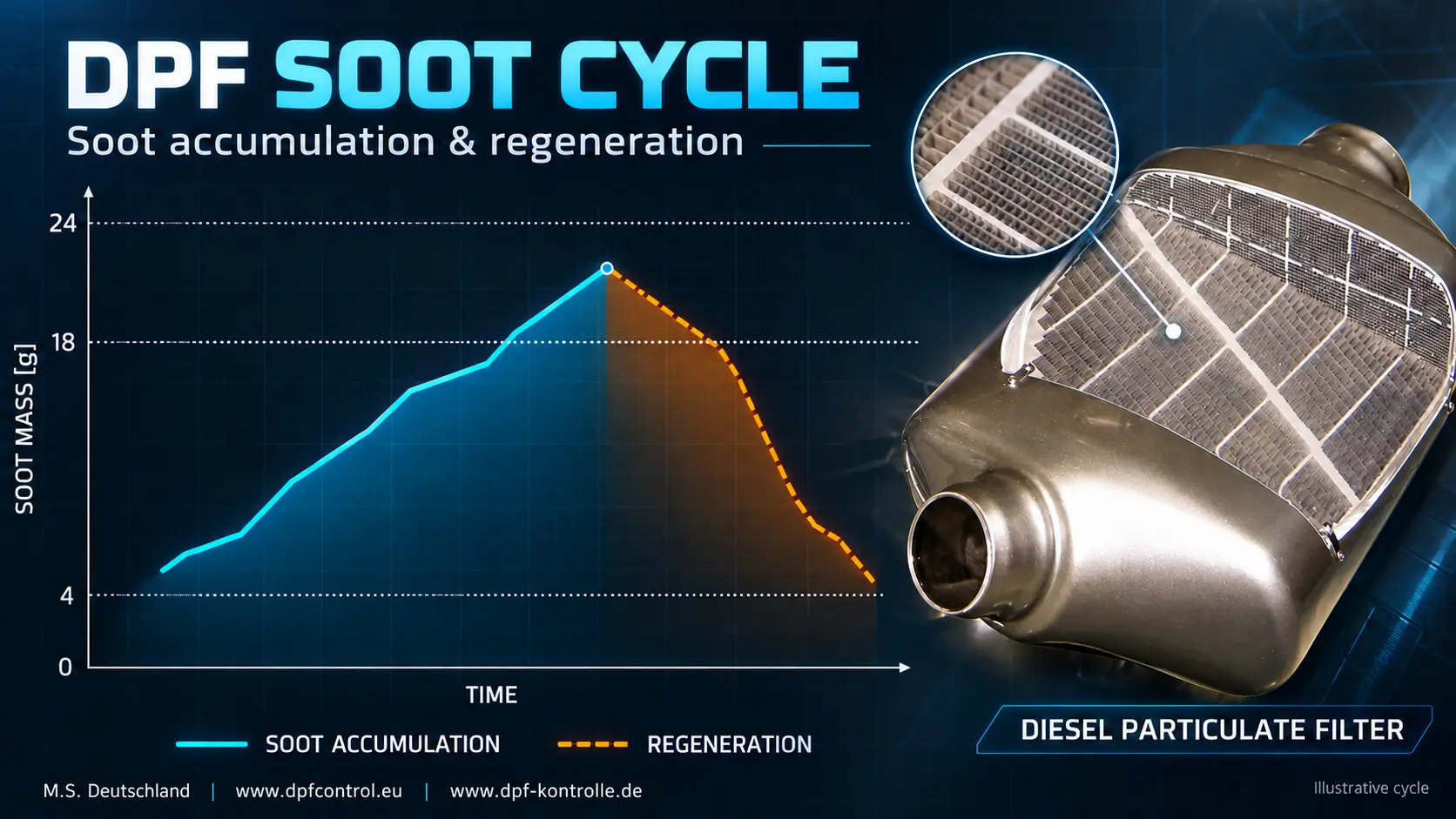
The diesel particulate filter traps soot from the exhaust. During normal use, soot accumulates. When the engine control unit determines that regeneration is needed and operating conditions allow it, the system raises exhaust temperature to burn off accumulated soot.
Soot accumulates
The filter collects particulate matter. The reported soot mass generally increases between cleaning cycles, although the exact pattern depends on driving conditions and passive soot oxidation.
Active regeneration starts
The ECU initiates its cleaning strategy. DPF Control recognises the supported regeneration status and alerts you that the process is running.
Soot loading falls
As regeneration progresses, soot is oxidised. When the reported active cycle ends, DPF Control gives an end indication. You can also check the available soot reading.
The graph illustrates the principle, rather than a fixed schedule for every engine. Its gram values are examples: regeneration thresholds, duration and residual soot mass vary between vehicles. A lower soot reading after regeneration is normal; the filter does not have to reach zero grams.
Soot and ash are different. Regeneration burns combustible soot. Non-combustible ash remains in the filter and can eventually require appropriate servicing or replacement. A soot reading is therefore useful information, but it is not a complete assessment of the filter’s remaining service life.
AUTOMATIC INFORMATION, SIMPLE DAILY USE
How the DPF Control Regeneration Monitor Works
DPF Control connects to the vehicle’s OBD2 diagnostic socket and uses information available from the engine control unit. With the correct version for your car, it monitors active regeneration automatically and provides light and sound alerts.
Start the car. DPF Control starts monitoring.
There is no phone to pair or app to open at the start of every journey. Regeneration alerts arrive without having to watch live graphs or operate a screen while driving.
Check the soot level when you need it.
A short button press requests the available soot value in grams, communicated through the device’s signal sequence. Check it while safely parked and follow the instructions supplied with your version.
The value comes from the vehicle’s diagnostic data; the device does not physically weigh soot in the filter. Data availability depends on the ECU and the selected DPF Control version.

Over time, this gives you a useful picture of your own car: how soot loading changes during your usual journeys, when active cleaning tends to occur and whether the pattern has changed. There is no need to compare your car with a supposedly universal regeneration interval.
The engine ECU remains in charge of regeneration. DPF Control informs you about the process. It does not choose when regeneration starts, force a cleaning cycle or change engine software. For a detailed explanation, visit how DPF Control works .
WHY THAT INFORMATION MATTERS
Six Benefits of Giving Regeneration Time to Finish
Knowing that regeneration is running gives you the opportunity to avoid unnecessary interruptions. That matters particularly when short journeys repeatedly end before the cleaning cycle has achieved its target.
1. Fewer avoidable incomplete cleaning cycles
If the engine is switched off before regeneration finishes, some of the soot targeted by that cycle may remain. The ECU can attempt regeneration again when suitable conditions return. Repeating this pattern can make soot management more difficult and contribute to excessive loading. Ford explains how short trips and frequent engine shutdowns can prevent successful regeneration.
With a regeneration alert, you know when continuing a normal, steady drive may be worthwhile. One unavoidable interruption does not automatically damage the filter; avoiding a recurring pattern is the practical goal.
2. Less exposure to repeated fuel-dilution conditions
Some diesel engines use late in-cylinder fuel injection to generate the exhaust heat needed for regeneration. A proportion of that fuel can reach the cylinder walls and mix with the engine oil. Repeated regeneration attempts can increase exposure to this mechanism.
Excessive fuel dilution can reduce oil viscosity and weaken the lubricating film, increasing the risk of premature wear. If severe lubrication problems are left unresolved, serious engine damage — including seizure — can result. TotalEnergies describes the effects of fuel dilution on lubrication and engine components.
Helping a cycle finish can reduce the need for avoidable repeat attempts. DPF Control monitors regeneration status; regular oil-level checks and the manufacturer’s oil-service requirements remain essential.
3. Less exhaust restriction from excess soot
As soot loading increases, it can increase the resistance to exhaust flow through the filter. The engine must work against that restriction, and excessive loading can affect performance and fuel efficiency.
Successful regeneration removes soot and helps keep the soot-related pressure drop under control. Research published by SAE International links heavy soot deposits with increased pressure losses and reduced engine efficiency. Supporting normal cleaning helps limit the extra work associated with pushing exhaust gases through an excessively soot-loaded filter.
4. Fewer unnecessary high-temperature repeat attempts
DPF regeneration involves substantial heat. Letting a normal cycle complete can avoid the need for additional attempts caused by repeatedly stopping it early. Keeping soot loading under control also supports normal filter operation.
Thermal stress depends on soot mass, temperature distribution, exhaust flow and the ECU’s protection strategy. SAE research explains why these factors matter for thermal-shock protection. Normal regeneration is part of the filter’s design. Avoiding repeated incomplete cycles can support its long-term care, but there is no fixed extension of DPF life that a monitor can guarantee.
5. Less avoidable fuel use from repeated cleaning
Active regeneration can temporarily increase fuel consumption because the system needs extra heat. If the same cleaning task has to be attempted repeatedly, additional regeneration-related fuel use may follow.
Knowing when a cycle is underway helps you make sensible use of a journey already in progress. The result depends on your vehicle and routes; extending every trip regardless of circumstances would not automatically save fuel.
6. Earlier awareness of a changed regeneration pattern
If your car suddenly regenerates much more frequently, takes longer than usual or repeatedly fails to reduce its soot reading, that change is useful information. You can describe the pattern to a workshop instead of relying on a vague impression that something is different.
DPF Control helps you observe what is happening. A persistent abnormal pattern still needs diagnosis: short trips are only one possible explanation, alongside sensor, temperature-management, injection or filter-condition problems.
SMALL DEVICE. USEFUL INFORMATION.
Compact Enough for Everyday Use
The dimensions shown are approximately 48 × 31 × 25 mm. The compact module connects to the OBD2 socket, while the separate LED can be placed where its indication is easy to notice.
Installation does not require cutting vehicle wiring or modifying ECU software. Depending on the position of the diagnostic socket and surrounding trim, an appropriate OBD2 extension cable may help achieve a suitable fit.
Position the module and cable so they cannot interfere with the pedals, steering or other controls. Once installed and configured for the vehicle, the monitor works automatically during everyday driving.

VOLKSWAGEN · AUDI · ŠKODA · SEAT · CUPRA · PORSCHE · BENTLEY
DPF Control for All VAG TDI Cars
DPF Control is designed for all cars with TDI engines from the Volkswagen Group. Whether you drive a compact hatchback, a family estate, a saloon or an SUV, the benefit is the same: know when active regeneration starts and ends, and check the soot level in your DPF.
That includes everyday TDI cars from Volkswagen, Audi, Škoda, SEAT and CUPRA, together with TDI-powered Porsche and Bentley models. The device gives drivers useful information for daily commuting, family journeys and longer trips alike.
Luxury diesel vehicles such as the Bentley Bentayga, Audi Q7 and Audi A8 are further examples of where DPF Control is useful. Their drivers also benefit from clear regeneration alerts and soot information: a sophisticated vehicle still needs suitable conditions for its DPF cleaning cycle.

Choose the version for your car in the DPF Control online shop . Provide your engine code or VIN when ordering so we can match the correct device version to your TDI engine.
MAKE THE INFORMATION WORK FOR YOU
What to Do When Regeneration Begins
- Notice the alert. Continue driving normally; no smartphone interaction is needed to receive regeneration notifications.
- If safe and practical, allow time for the cycle. A steady journey with suitable operating conditions can help the ECU complete regeneration. Follow your vehicle’s handbook rather than one universal speed or RPM rule.
- Listen for the end indication. This tells you that the monitored active regeneration status has ended. You can check the soot value while safely parked if you want to follow the loading trend.
Road safety and the vehicle’s condition come first. If you must stop, stop normally. If a DPF warning remains on, the oil level rises beyond the permitted limit or the car develops a persistent fault or loss of power, follow the manufacturer’s instructions and arrange diagnosis.
YOUR QUESTIONS ANSWERED
DPF Control: Frequently Asked Questions
Does DPF Control need a smartphone, app or internet?
No. It works as a standalone OBD2 monitor. Regeneration notifications use the device’s light and sound signals, so you do not have to open an app for every drive.
Can I check how many grams of soot are in the DPF?
Yes, with a compatible vehicle and the correct device version. A short button press requests the soot reading reported by the vehicle’s ECU, communicated using the device’s signal sequence. Follow the instructions for your version and check it while safely parked.
Can DPF Control start regeneration whenever I want?
The engine control unit decides when regeneration can begin. DPF Control monitors that process and informs you. It does not initiate a forced regeneration or change the vehicle’s cleaning strategy.
Will one interrupted regeneration damage my engine?
One interruption does not automatically cause damage. Repeated incomplete cycles are the concern because soot can remain and further attempts may be needed. In engines using in-cylinder post-injection, regeneration can also contribute to fuel dilution of the oil.
Which VAG TDI cars is DPF Control for?
DPF Control is for all VAG cars with TDI engines across Volkswagen, Audi, Škoda, SEAT, CUPRA, Porsche and Bentley. Include your engine code or VIN when ordering so we can match the correct device version to your engine.
Does a low soot reading mean the DPF is completely clean?
A low reading after regeneration indicates reduced reported soot loading. It does not measure remaining ash or confirm that every component is fault-free. Regeneration burns soot; ash accumulates over time.
For more product questions, visit the DPF Control FAQ or contact our support team .
LESS GUESSWORK ON EVERY JOURNEY
Choose Your DPF Control and Order Online
For VAG TDI drivers across Volkswagen, Audi, Škoda, SEAT, CUPRA, Porsche and Bentley, DPF Control brings useful information into everyday driving: when active regeneration starts, when it ends and the available soot reading in grams. That gives you a practical opportunity to avoid unnecessary interruptions and take better-informed care of your diesel.
DPFControl.eu is available in multiple languages. Choose your preferred language using the website’s language selector, explore the products and order the appropriate version online.
UK customers are welcome. We ship to the United Kingdom via DHL. Check the delivery information and checkout details for your destination when ordering.
Before ordering, check the product information and include your engine code in the order notes, or provide the VIN if the engine code is unavailable. If you are unsure, contact us with the make, model, engine and year so we can check compatibility.
DPF Control. Start the car. Stay informed.
Technical Background
- Ford: diesel particulate filters, regeneration and driving patterns .
- TotalEnergies: fuel dilution of engine oil — causes and effects .
- SAE International, paper 2020-01-2176: soot loading, pressure loss and active regeneration .
- SAE International, article 2011-01-2429: thermal-shock protection for diesel particulate filters .
Vehicle-specific operating and maintenance instructions are provided by the vehicle manufacturer. Product functions and available readings depend on the selected DPF Control version and the vehicle’s diagnostic support.